
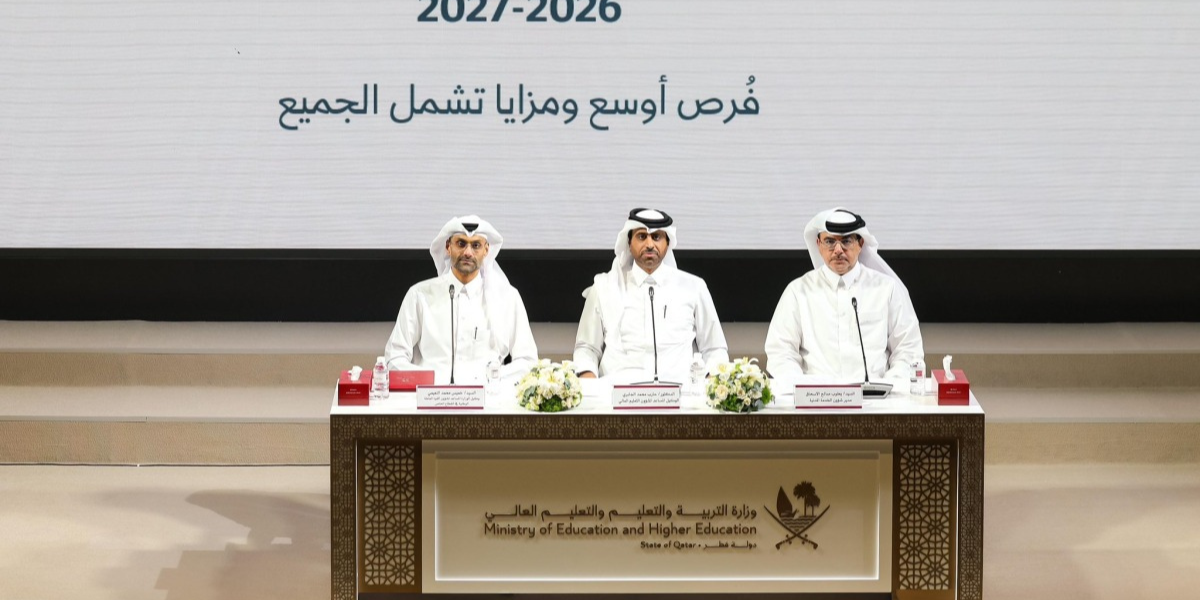
The Ministry of Education and Higher Education (MoEHE) has announced the launch of the Government Scholarship Plan for the 2026–2027 academic year, introducing an expanded package of programmes and benefits aimed at strengthening national human capital and aligning higher education outputs with labour market priorities.
The plan was revealed during a press conference held yesterday at the Ministry’s headquarters. Officials said the updated scholarship framework reflects a forward-looking approach focused on inclusion, empowerment, and preparing students for future national needs.
A key feature of the new plan is the introduction of a dedicated scholarship track for students with disabilities, enabling them to pursue studies at specialised international universities. The programme also includes a new “bridging” pathway that allows students from humanities streams to transition into scientific disciplines. In addition, several priority fields have been added, including nuclear engineering and clinical psychology.
MoEHE has announced two application windows through the Government Scholarship Platform. The first phase, covering external scholarships, Education City universities and private universities, will open from July 1 to August 15, 2026. The second phase, designated for Qatar University and other public institutions, will run from November 15 to December 30, 2026. Scholarships will be awarded based on merit and academic excellence.
Speaking at the press conference, Dr Hareb Al Jabri, Assistant Undersecretary for Higher Education Affairs at MoEHE, said the plan reflects the Ministry’s commitment to ensuring equal access to educational opportunities. He explained that the updated scholarship tracks prioritise inclusivity while guiding Qatari students toward specialised fields that support national development objectives and Qatar National Vision 2030.
For his part, Al Nuaimi noted that the initiative complements the Ministry of Labour’s efforts to enhance job readiness among Qatari students, in cooperation with private-sector partners. He said the programme aims to help build a skilled, motivated workforce capable of contributing effectively to a knowledge-based economy.
Meanwhile, Yaqoub Al Ishaq, Director of Civil Service Affairs at the Civil Service and Government Development Bureau, described the scholarship plan as a strategic pillar for developing national talent. He underlined that the 2026–2027 programme goes beyond academic sponsorship, offering a comprehensive framework that links scholarships to actual government workforce needs and provides clear career pathways after graduation.
The plan also includes a competitive financial package across its various tracks. Medical students under the Amiri Scholarship Programme will receive base salaries in addition to monthly travel allowances. Under the “Tomouh” programme, male students are guaranteed immediate employment with competitive monthly salaries of around QR23,000.
Monthly stipends vary depending on the scholarship type and specialisation. These include QR20,000 for Amiri scholarships abroad, between QR18,000 and QR30,000 for overseas medical specialisations, QR20,000 for nuclear engineering scholarships abroad, approximately QR23,000 under the Tomouh programme, around QR14,000 for general external scholarships, and between QR4,000 and QR10,000 for internal scholarships. Additional benefits include allowances, annual travel tickets, and in some cases the inclusion of study years within total years of service.
The scholarship framework comprises three main tracks: the Amiri Scholarship Programme for leading international universities, the External Scholarship Programme based on approved institutions and academic tracks, and the Internal Scholarship Programme at accredited national universities. These are supported by employment-linked programmes aligned with national development priorities.
The plan places strong emphasis on priority disciplines identified as critical to Qatar’s future needs. These include advanced engineering and technology, computer science and information technology, medicine and health sciences, psychology and behavioural health, and fields linked to economic development. The selected specialisations are based on government workforce requirements, private-sector localisation programmes, and future-oriented academic trends.
Applicants are required to meet specific criteria, including achieving a high school average of between 75 and 80 percent depending on the programme, obtaining unconditional admission from approved universities, securing a minimum IELTS score of 6.0 or its equivalent for external scholarships, and ensuring consistency between their academic track and chosen field of study.